
Why agentic AI expands the attack surface
The risk changes when a model can read private data, consume untrusted content, and communicate or act outside the system.
Generation is not execution
A chatbot that drafts text can still expose data or mislead a user, but an agent with tools can turn a manipulated instruction into a durable external effect. The security question is no longer only what the model says. It is what the surrounding application permits the model to read, propose, and execute.
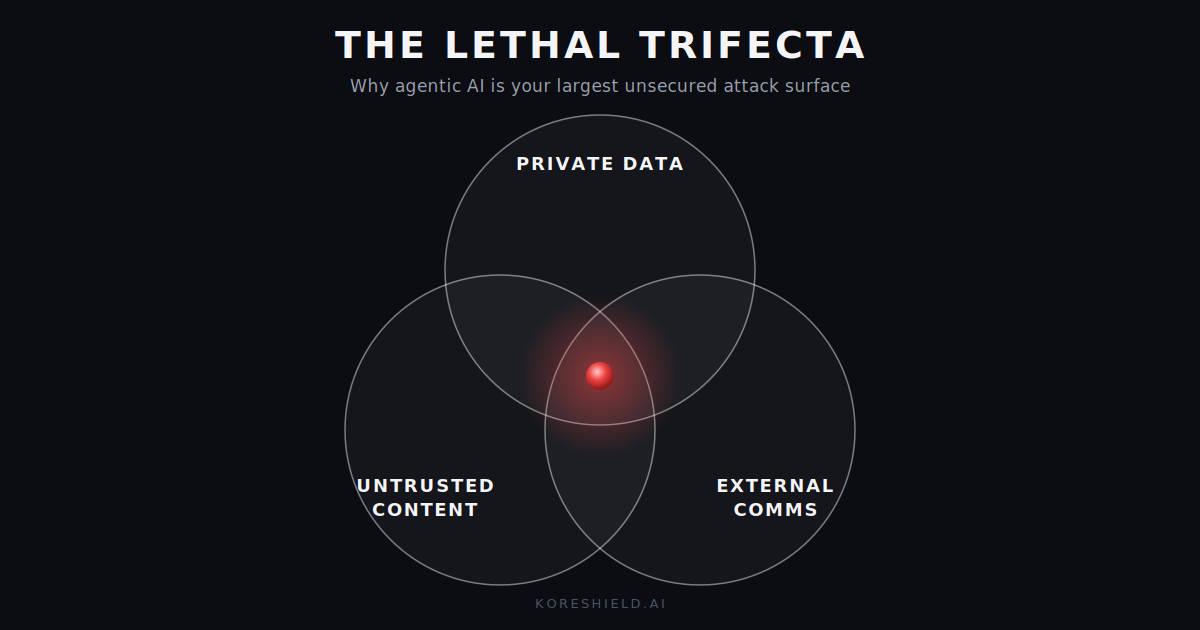
The highest-risk configuration combines access to private data, exposure to untrusted content, and a channel for external communication or action. Remove any one capability and the blast radius falls. Combine all three without independent controls and a poisoned document or message can become an operational instruction.
Design for least agency
Give each agent the narrowest data view and tool set needed for one task. Prefer purpose-specific operations over general shell, browser, SQL, or HTTP access. Bind every proposed action to the authenticated user and current tenant rather than trusting identity or authority stated in model-generated text.
- Separate read tools from write tools and use different credentials.
- Require explicit schemas and reject unknown tool arguments.
- Use destination and resource allowlists for outbound operations.
- Set transaction limits, idempotency keys, and approval thresholds outside the model.
- Log the proposed action, authorization result, execution result, and originating evidence.
Inspect the proposed action
Koreshield's /v1/tools/scan boundary receives a tool name, arguments, and application context before execution. In detect mode it can record a risky proposal without interrupting traffic; in enforce mode a block decision returns before the tool runs.
That inspection complements authorization. It does not replace ownership checks, financial controls, consent, or regulator-required review. The application remains the final authority.
Build a failure path before autonomy
An agent should know how to stop. Define what happens when retrieved context is rejected, an action is denied, a dependency times out, or evidence is incomplete. A safe fallback can be a read-only response, a request for clarification, or a human review queue.
Autonomy without a tested refusal and recovery path is not operational maturity. It is simply permission with uncertain behaviour.